

Luoyang Lutong Heavy Industry Machinery Co., Ltd.

Case
Types Of Rollers Commonly Used In Construction Projects

6 Types of Rollers Commonly Used in Construction Projects

6 Types of Rollers Commonly Used in Construction Projects


Most construction sites need a stable ground to do their work on. The soil needs to be compressed so there aren’t any pockets of air underground that can      disrupt the process.


For this to work, special construction equipment is needed to properly compact and smooth the ground. One of the most common types of compaction equipment is the road roller. Road rollers have a long history, with some of the first being pulled by a horse    and used for agricultural purposes. In fact, modern    rollers are still referred to as steam rollers, from when they were powered by a steam engine.


Although the “steam” part of the name has stuck around, rollers are rarely (if ever) powered by steam and are much more specialized in the type of                compacting they do. Due to their specialties, one roller won’t really work the same as another as a  sheepsfoot roller is very different than a pneumatic tire    roller.


Knowing about the different types of rollers is important information for a construction project. To help you choose the right machine, we've broken down    the different types of rollers and their uses below.
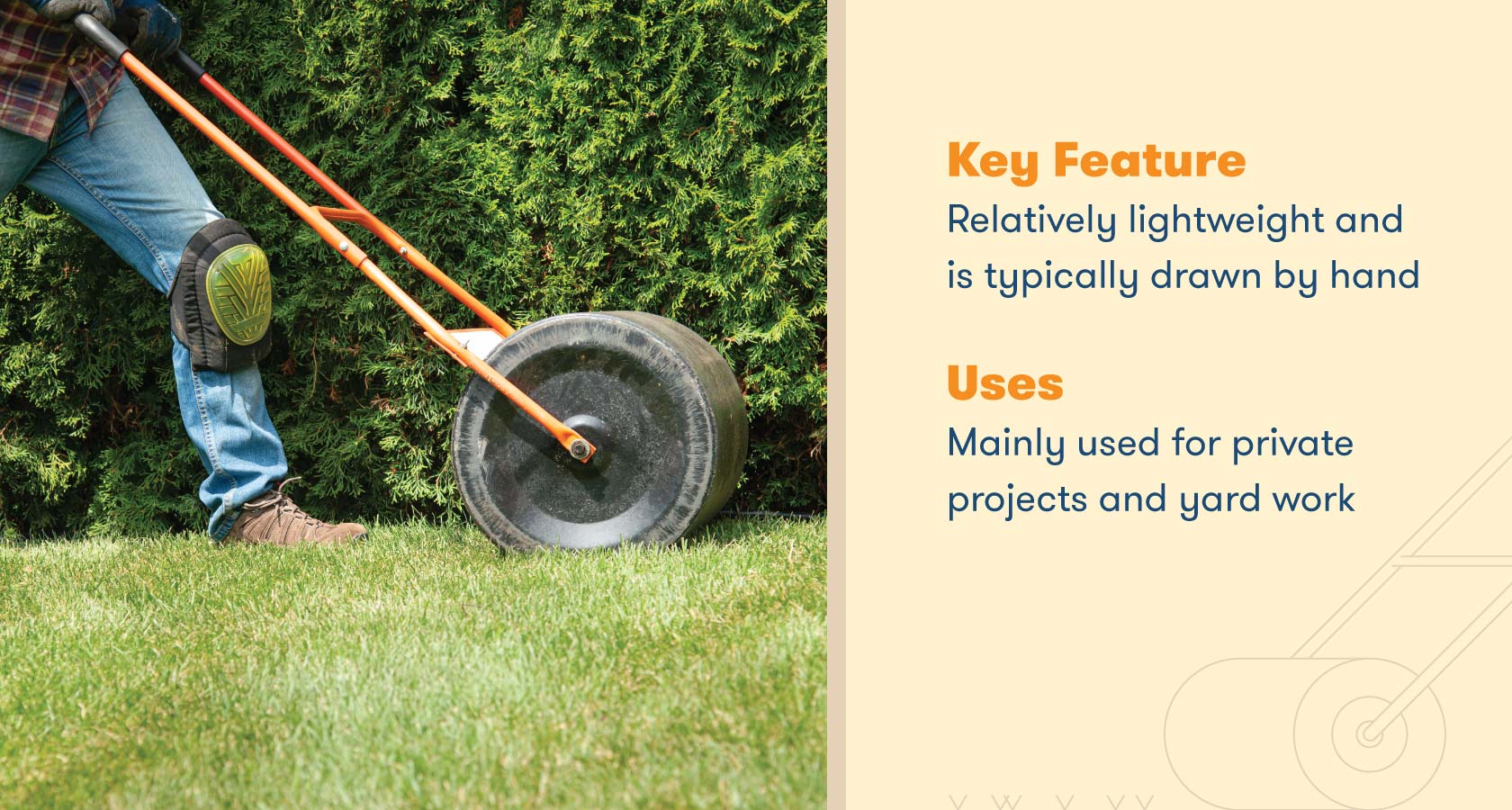
1. Cylindrical Rollers

relatively lightweight and is typically drawn by hand

One type of walk-behind roller is a cylindrical roller. These ones are traditional in that they are relatively lightweight and are pushed by a person. All of the  other types of rollers on this list have walk-behind and ride-on counterparts and are sometimes still powered by an engine.


Cylindrical rollers are used mainly for small and private projects, like yard work. Cylindrical rollers are typically 1 meter in diameter  and are generally        made of iron, stone or concrete.
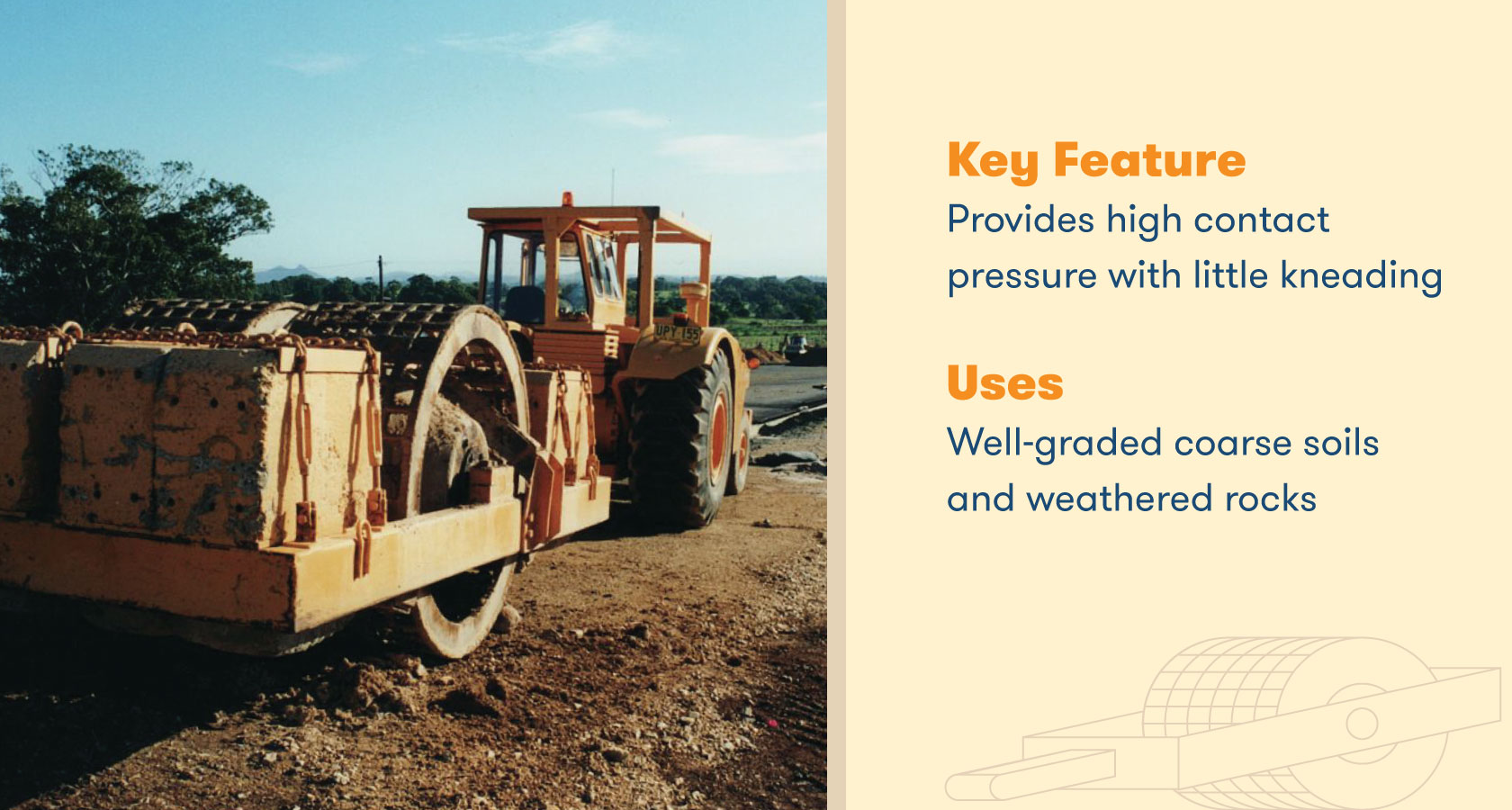
2. Grid Rollers

Provides high contact pressure with little kneading

Left: “Hyster Grid type roller” by Dw1975, via Wikimedia Commons, used under Creative Commons Attribution 2.0 license.


Grid rollers are a type of roller that has a network of steel bars, which create a grid-like pattern on the steel drum. The grid may also be ballasted with          

concrete blocks or steel attachments for more contact pressure. These types of rollers are generally towed or  pulled behind a tractor or another heavy           machine.


The grid design on the cylinder drum produces a high contact pressure with little kneading action on compaction work. Because of this, they're most              suitable on well-graded, coarse soils, weathered rocks and for subgrade and sub-base road constructions.
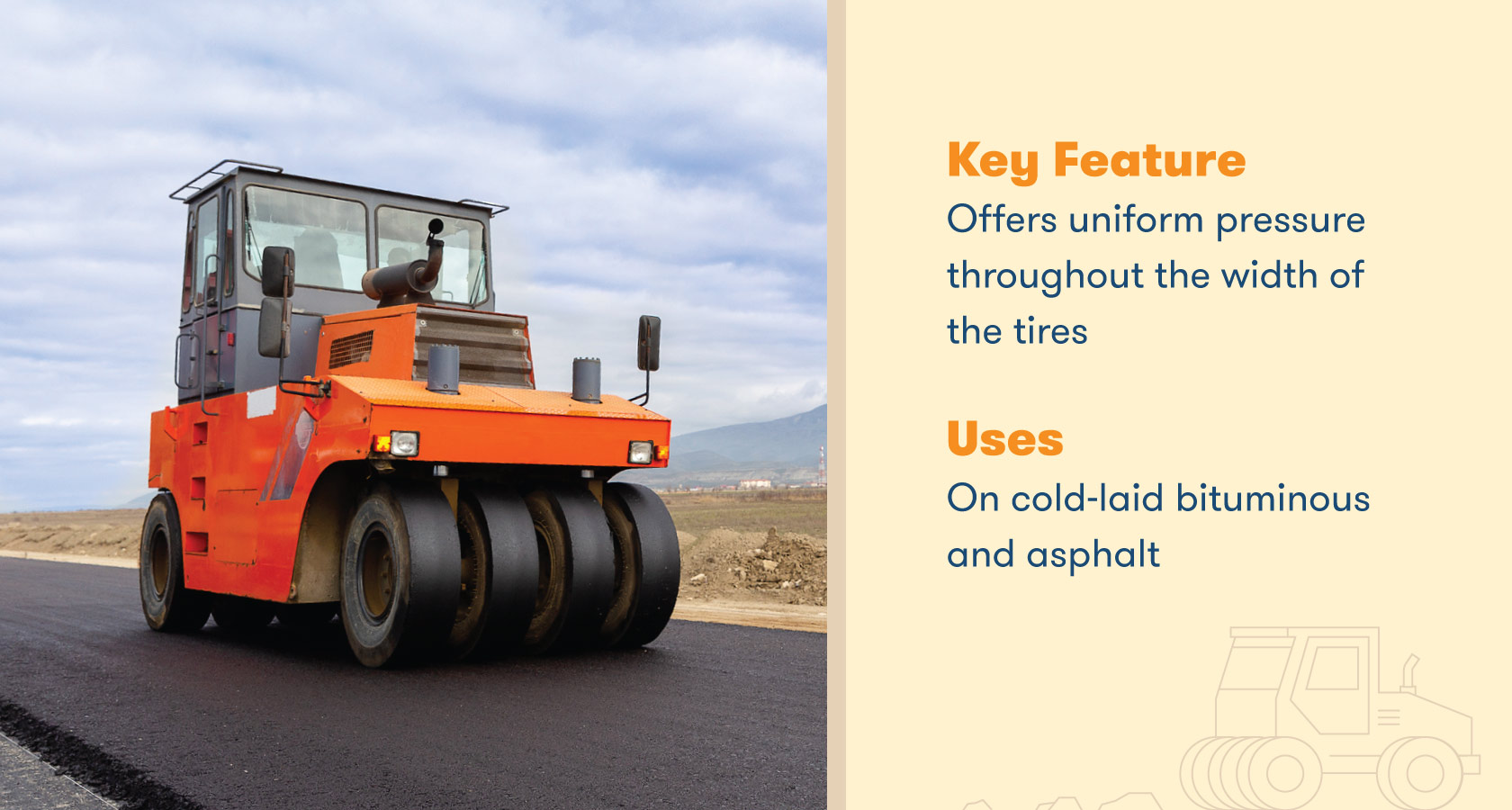
3. Pneumatic Rollers

Offers uniform pressure throughout the width of the tires

Pneumatic rollers, sometimes called pneumatic tired rollers, are a type of large, ride-on roller with several rows of rubber tires on    the front or rear end.      The rubber tires provide an 80% coverage area and uniform pressure throughout the width of the tires.They   are typically used for pavements and can help    smooth out and polish a project, but are also great for cold-laid bituminous or cold mixed pavements and layers of loose soil.
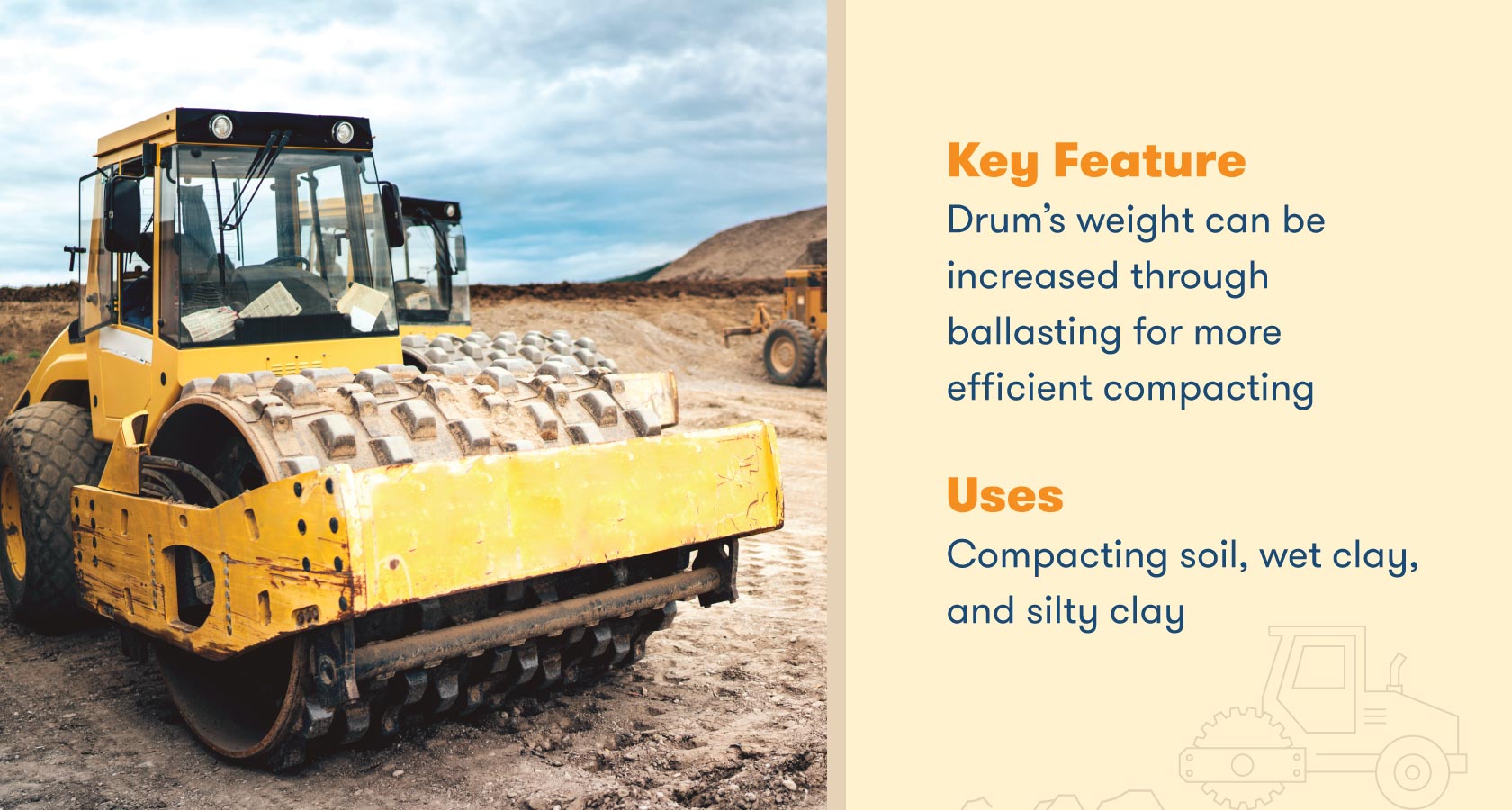
4. Sheepsfoot

Drum's weight can be increased through ballasting for more efficient compacting

Sheepsfoot rollers, otherwise known as padfoot or tamping rollers, are rollers with many rectangular-shaped lugs, or "feet."  They're great for compacting     soil and silty clay in road construction work.


The sheepsfoot drum’s weight can be increased by ballasting it with water, damp sand, or mounting steel sections onto it, providing a more efficient compact-ing job. Likewise, any projects with wet clay or other fine-grained soils at great depths should    use this type of roller. You can finish off areas compacted   by sheepsfoot rollers by going over them with a pneumatic roller.

5. Smooth Wheeled or Static Rollers

There are generally two types of smooth wheeled rollers: single and double drum roller. They are also known as static rollers.
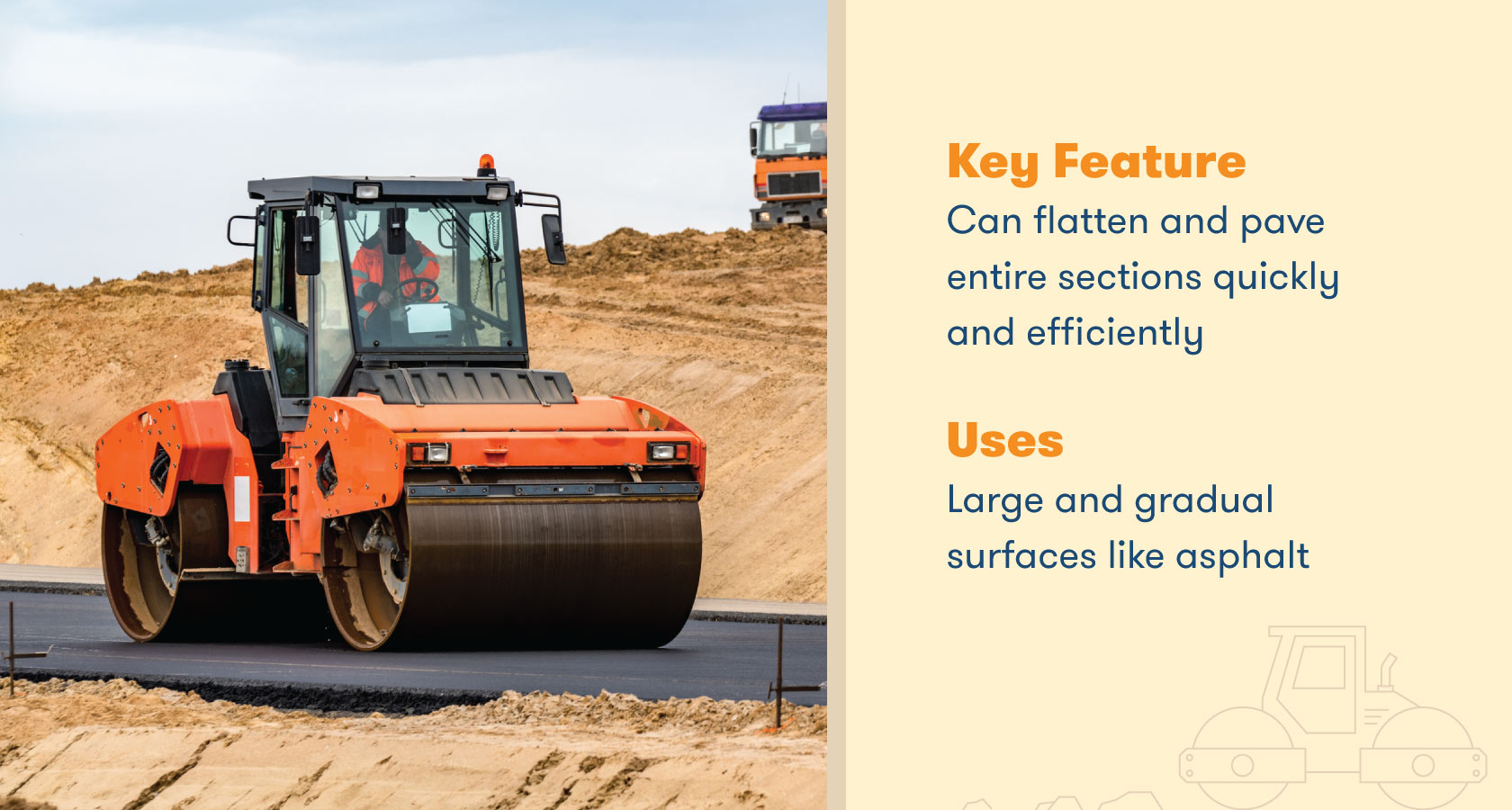
Double Drum or Tandem

can flatten and pave entire sections quickly and efficiently

The tandem, or double drum roller, has one steel drum in the front and one in the back. As the two drums move, this moves the  roller. The efficiency of         the tandem roller comes from the two drums — entire sections of a highway can be flattened and paved quickly and efficiently. These rollers are great for    flat or gradual surfaces like asphalt, but because they have very little traction, they're not recommended  for anything specialized.
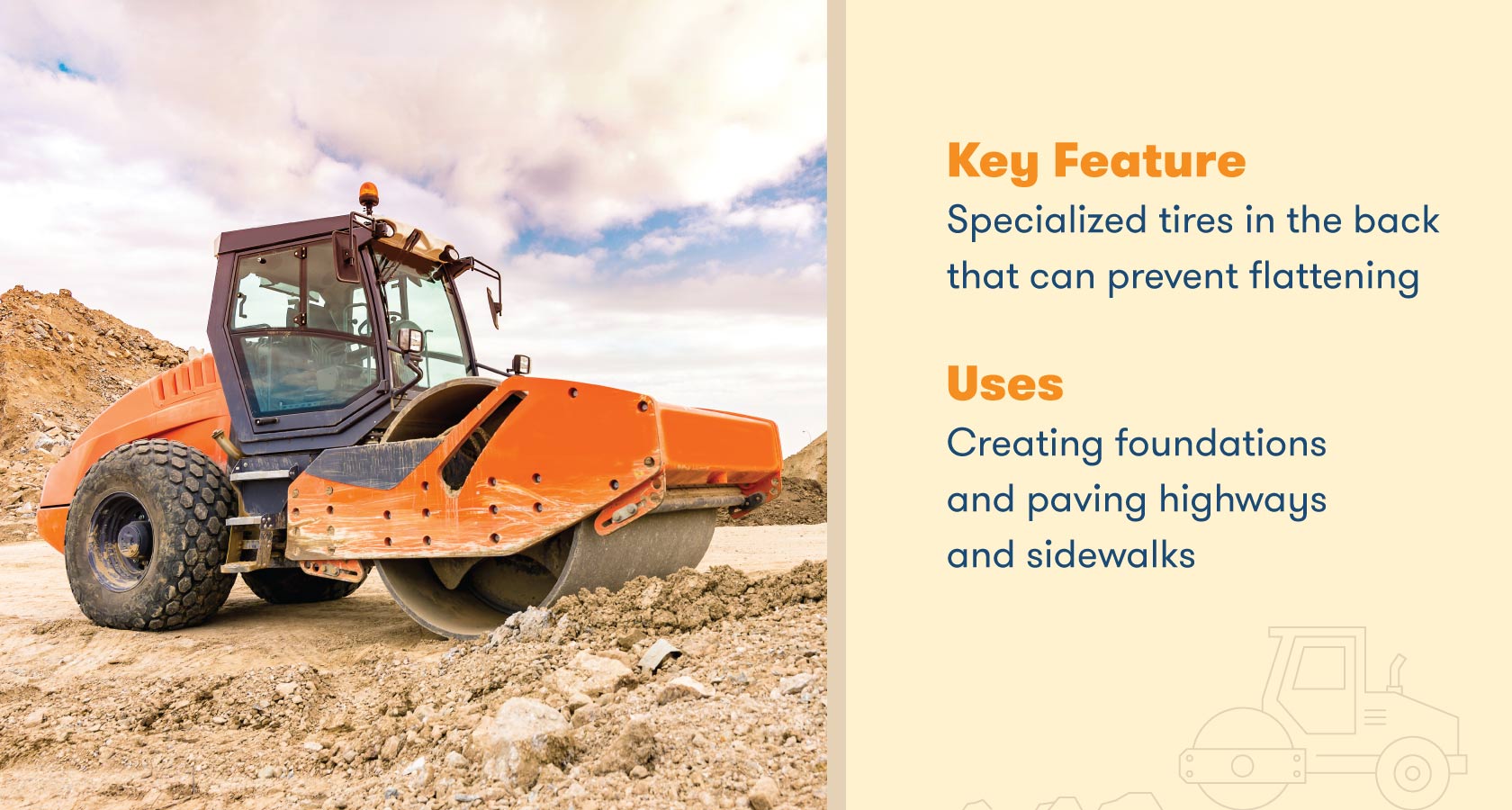
Single Drum or Three-wheeled

Specialized tires in the back can prevent flattening

Three-wheeled or single drum rollers are some of the most common pieces of heavy-duty machinery. When people think of road rollers, they typically          picture a three-wheeled roller.They typically have a steel drum in the front and two special wheels in the back that can prevent most flat tires from happening


Single drum rollers can work in tighter spaces and more specialized projects due to their smaller size. They’re great for creating foundations for buildings     and paving highways or sidewalks, but because of the extra weight in the front, they won’t roll over some surfaces.


One thing to note is that single-drum can also refer to other rollers, such as the padfoot or smooth roller. Understanding that aspect can help differentiate        exactly what you need.
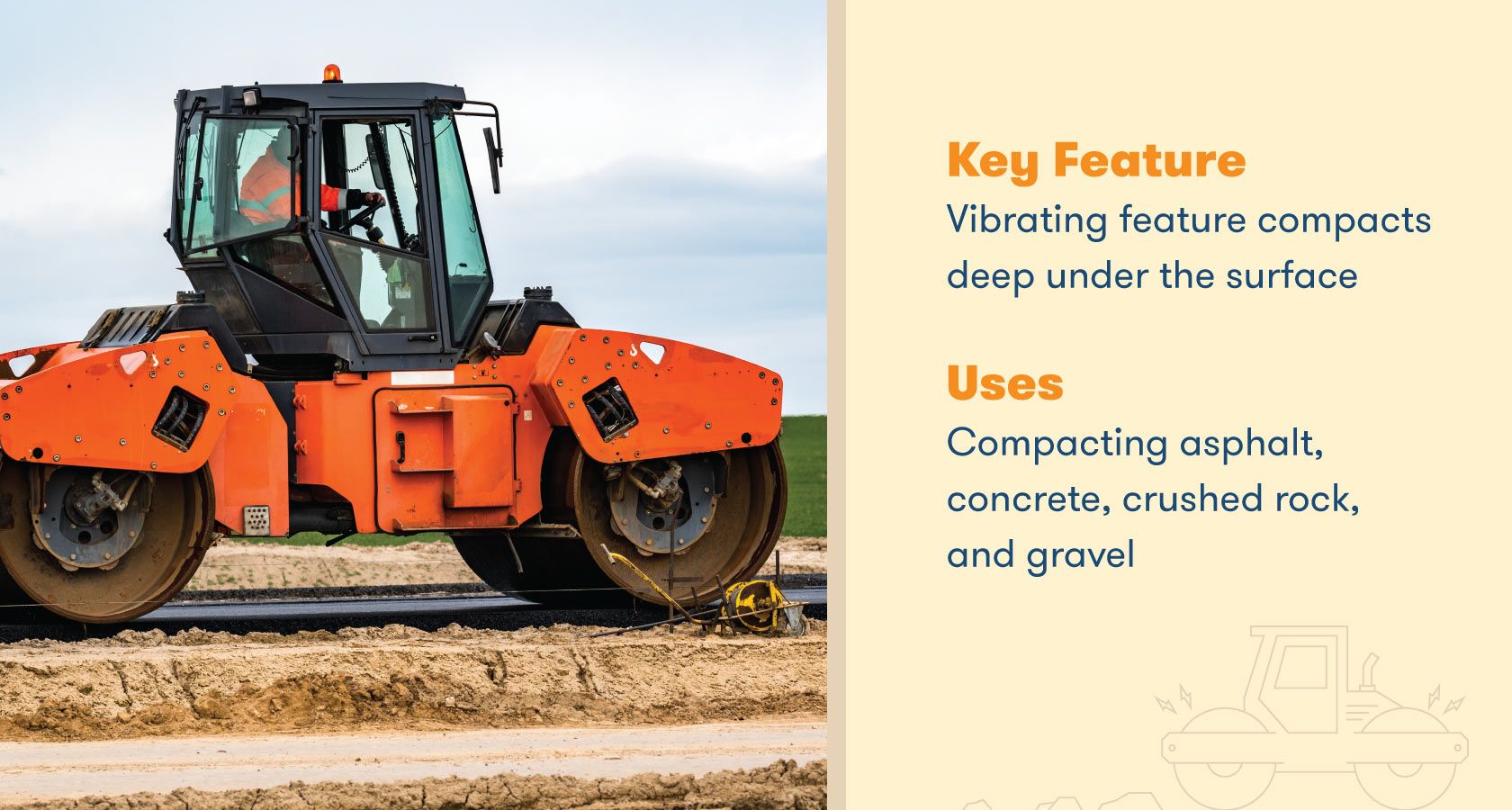
6. Vibratory Rollers

Vibrating feature compacts deep under the surface

Vibratory rollers are almost identical to smooth wheel rollers (including the single and double drum) except for one major  difference: they come with a        specialized vibrating component. As the roller compacts and flattens the surface, it will vibrate.


Since soil, asphalt, and concrete have natural empty spaces, they can cause a building to warp and sink, causing damage to the    structure. Using a vibratory roller on your construction project can help keep the building’s structural integrity. Other types of soil that vibratory rollers are great at compacting are          crushed rock or gravel.

Other Types of Compactor Equipment

Rollers aren’t the only construction tools used for compaction work. Other types of compactor equipment include the rammer  and the vibratory plate.          Rammers are handheld and are best used for small jobs in tight areas. Due to their comparatively lightweight, they can be hand or machine operated, which  allows deep vibratory compaction.


Vibratory plate compactors are used to increase the density of a variety of soils and fill any voids. Because they are walk-behind compactors and are smaller in size, these compactors are best used for tight spaces where large equipment can’t reach.

How to Choose the Right Type of Road Roller

Choosing the right type of roller for your construction project is important, as the wrong one can result in poor workmanship,  pockets of air that’ll sink the  structure or uneven spaces that can be dangerous.


Figuring out the right type of roller depends on a few factors. The first of which would be the length of the project. Depending on   the length, sometimes it’ll be more cost-efficient to rent a roller than outright buying one.


You’re also going to have to figure out the type of soil that’s going to be compacted. Fine-grain sand will need a different roller  than clay. Plus, if you’re      laying asphalt, you’re going to have to figure out if it’ll be better to have a static or a vibratory roller.

Figuring out whether you need a smooth vs padfoot roller for your project might seem difficult at a glance, but learning about the  two rollers (and others)    can definitely help you pick the right type of roller for your construction project.


Rollers are great at improving and repairing surfaces, making them some of the most trustworthy heavy equipment you can use on a project. Understanding  the benefits of each roller can make choosing the right one for your project simpler.


We use cookie to improve your online experience. By continuing to browse this website, you agree to our use of cookie.

Cookies

Please read our Terms and Conditions and this Policy before accessing or using our Services. If you cannot agree with this Policy or the Terms and Conditions, please do not access or use our Services. If you are located in a jurisdiction outside the European Economic Area, by using our Services, you accept the Terms and Conditions and accept our privacy practices described in this Policy.
We may modify this Policy at any time, without prior notice, and changes may apply to any Personal Information we already hold about you, as well as any new Personal Information collected after the Policy is modified. If we make changes, we will notify you by revising the date at the top of this Policy. We will provide you with advanced notice if we make any material changes to how we collect, use or disclose your Personal Information that impact your rights under this Policy. If you are located in a jurisdiction other than the European Economic Area, the United Kingdom or Switzerland (collectively “European Countries”), your continued access or use of our Services after receiving the notice of changes, constitutes your acknowledgement that you accept the updated Policy. In addition, we may provide you with real time disclosures or additional information about the Personal Information handling practices of specific parts of our Services. Such notices may supplement this Policy or provide you with additional choices about how we process your Personal Information.


Cookies

Cookies are small text files stored on your device when you access most Websites on the internet or open certain emails. Among other things, Cookies allow a Website to recognize your device and remember if you've been to the Website before. Examples of information collected by Cookies include your browser type and the address of the Website from which you arrived at our Website as well as IP address and clickstream behavior (that is the pages you view and the links you click).We use the term cookie to refer to Cookies and technologies that perform a similar function to Cookies (e.g., tags, pixels, web beacons, etc.). Cookies can be read by the originating Website on each subsequent visit and by any other Website that recognizes the cookie. The Website uses Cookies in order to make the Website easier to use, to support a better user experience, including the provision of information and functionality to you, as well as to provide us with information about how the Website is used so that we can make sure it is as up to date, relevant, and error free as we can. Cookies on the Website We use Cookies to personalize your experience when you visit the Site, uniquely identify your computer for security purposes, and enable us and our third-party service providers to serve ads on our behalf across the internet.

We classify Cookies in the following categories:
 ●  Strictly Necessary Cookies
 ●  Performance Cookies
 ●  Functional Cookies
 ●  Targeting Cookies


Cookie List
A cookie is a small piece of data (text file) that a website – when visited by a user – asks your browser to store on your device in order to remember information about you, such as your language preference or login information. Those cookies are set by us and called first-party cookies. We also use third-party cookies – which are cookies from a domain different than the domain of the website you are visiting – for our advertising and marketing efforts. More specifically, we use cookies and other tracking technologies for the following purposes:

Strictly Necessary Cookies
These cookies are necessary for the website to function and cannot be switched off in our systems. They are usually only set in response to actions made by you which amount to a request for services, such as setting your privacy preferences, logging in or filling in forms. You can set your browser to block or alert you about these cookies, but some parts of the site will not then work. These cookies do not store any personally identifiable information.

Functional Cookies
These cookies enable the website to provide enhanced functionality and personalisation. They may be set by us or by third party providers whose services we have added to our pages. If you do not allow these cookies then some or all of these services may not function properly.

Performance Cookies
These cookies allow us to count visits and traffic sources so we can measure and improve the performance of our site. They help us to know which pages are the most and least popular and see how visitors move around the site. All information these cookies collect is aggregated and therefore anonymous. If you do not allow these cookies we will not know when you have visited our site, and will not be able to monitor its performance.

Targeting Cookies
These cookies may be set through our site by our advertising partners. They may be used by those companies to build a profile of your interests and show you relevant adverts on other sites. They do not store directly personal information, but are based on uniquely identifying your browser and internet device. If you do not allow these cookies, you will experience less targeted advertising.

How To Turn Off Cookies
You can choose to restrict or block Cookies through your browser settings at any time. Please note that certain Cookies may be set as soon as you visit the Website, but you can remove them using your browser settings. However, please be aware that restricting or blocking Cookies set on the Website may impact the functionality or performance of the Website or prevent you from using certain services provided through the Website. It will also affect our ability to update the Website to cater for user preferences and improve performance. Cookies within Mobile Applications

We only use Strictly Necessary Cookies on our mobile applications. These Cookies are critical to the functionality of our applications, so if you block or delete these Cookies you may not be able to use the application. These Cookies are not shared with any other application on your mobile device. We never use the Cookies from the mobile application to store personal information about you.

If you have questions or concerns regarding any information in this Privacy Policy, please contact us by email at . You can also contact us via our customer service at our Site.